


The afternoon school pickup should be routine. But at 3:07 p.m. on a Tuesday, when distracted parents merge with early commuters and impatient drivers jockey for position, American roads become measurably more dangerous than almost any other time of day.
Traffic risk in the United States is climbing, and drivers face an unprecedented combination of threats: more distractions than ever before, roads pushed beyond capacity, and shrinking reaction times in an era of constant connectivity.
The National Highway Traffic Safety Administration's latest public safety data paints a sobering picture: 17,140 motor vehicle fatalities during just the first half of 2025.
To understand exactly when drivers face the greatest risk, Mercury Insurance analyzed five years of anonymized internal claims data spanning 2021 to 2026, examining thousands of crashes down to the individual minute. The goal: identify the precise 10-minute windows when accidents are most likely to happen, broken down by weekday versus weekend patterns.
What emerged reveals a truth more nuanced than conventional wisdom about “rush hour.” The most dangerous time to drive isn’t a single moment—it's a predictable daily rhythm shaped by the collision of school schedules and commute patterns, amplified by weekend midday chaos.
Key Findings
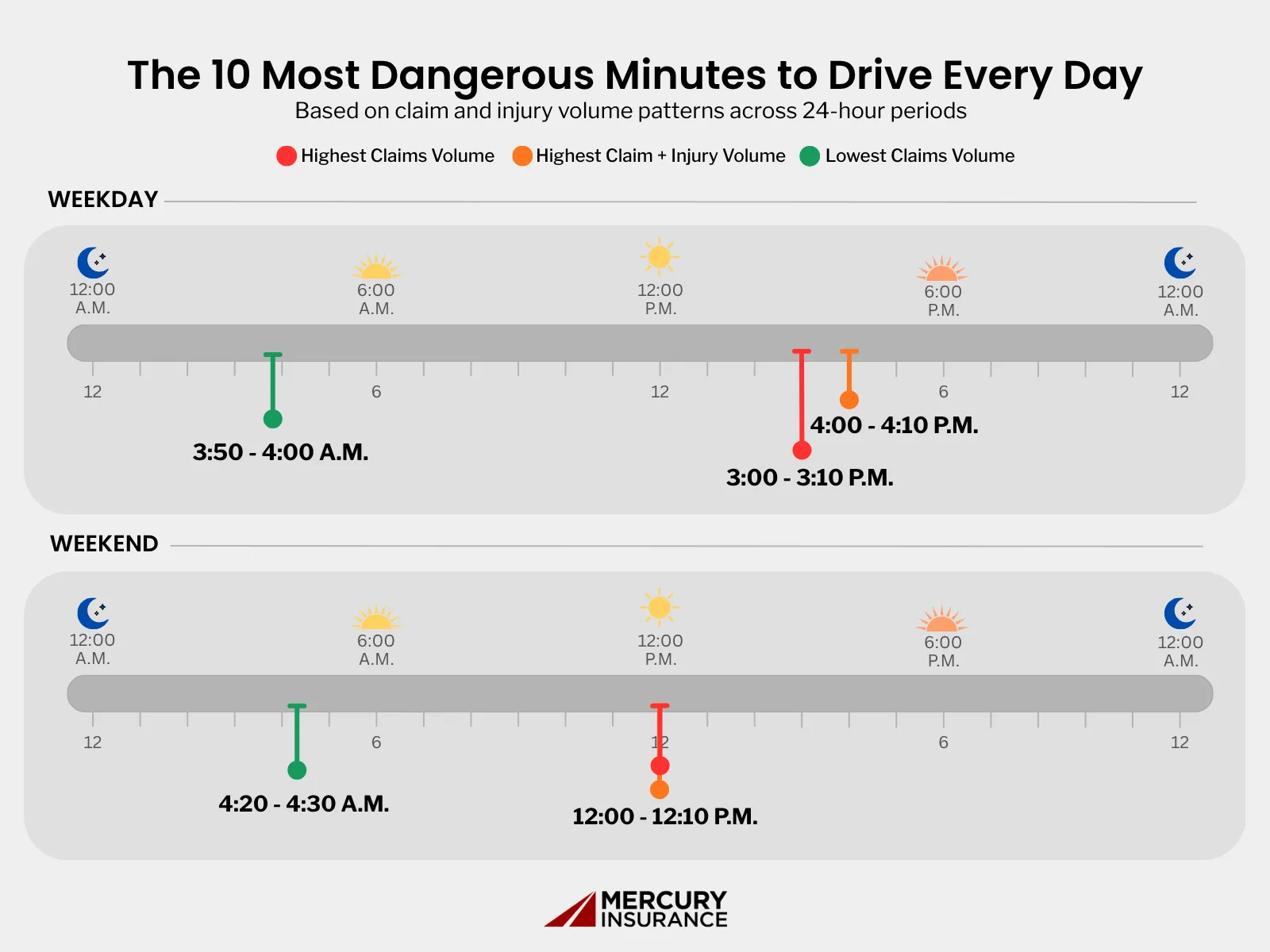
- On weekdays, 3:00–3:10 p.m. is the 10 most dangerous driving minutes, based on the number of accident claims during that window.
- However, the highest-risk weekday crashes occur between 4:00 and 4:10 p.m., when reported injuries peak, revealing a clear handoff from school pick-up congestion to the more dangerous afternoon commute.
- On weekends, the 10 most dangerous minutes shift to 12:00–12:10 p.m., likely due to increased midday travel rather than the more structured commutes.
- Crash volume has increased the most between 8:30 and 8:40 a.m. from 2021 to 2026, likely reflecting a rise in morning commuters returning to the roads post-pandemic.
- As expected, crash risk is lowest in the early morning hours, with the fewest incidents occurring between 3:00 and 4:00 a.m.
California Key Findings:
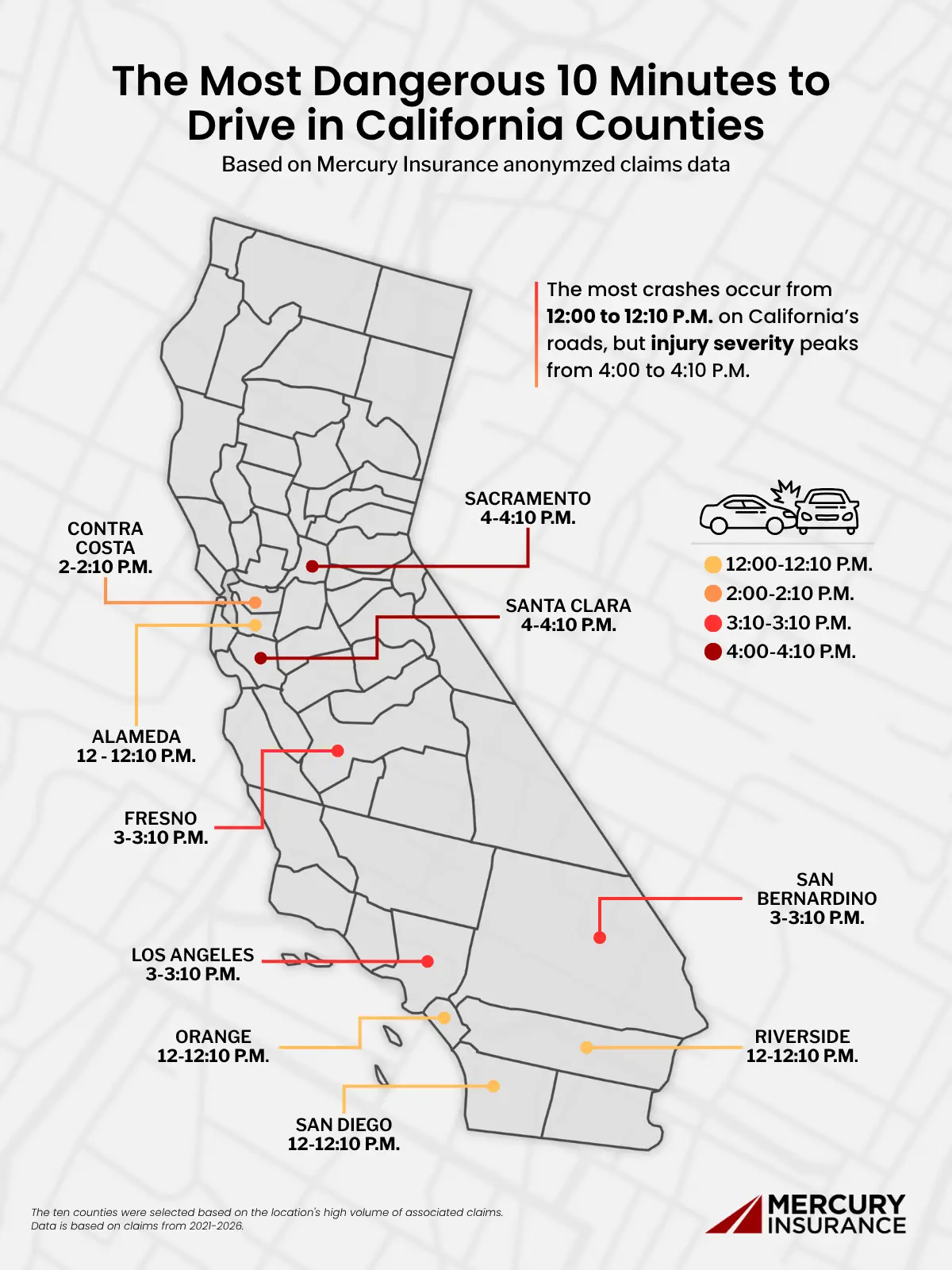
- In California, the most crashes occur between 12:00 and 12:10 p.m., with the highest-risk crashes occurring between 4:00 and 4:10 p.m.
- However, in some California counties, such as Los Angeles, Sacramento, and San Bernardino, crash volume peaks later in the afternoon.
The 10 Most Dangerous Minutes to Drive Every Day
Based on five years' worth of anonymized claims data, the most dangerous times to drive follow clear, predictable patterns tied to daily traffic trends. On weekdays, the highest-risk 10-minute window occurs between 3:00 and 3:10 p.m., when school pickup traffic overlaps with the start of the afternoon commute. The safest period falls between 3:50 and 4:00 a.m., when roads are at their quietest.
However, on weekdays, the highest-risk crashes occur slightly later in the afternoon, between 4:00 and 4:10 p.m., when injuries are most concentrated. Risk level was determined based on the volume of claims and the number of people involved who were injured as a result of the accident.
On weekends, the risk shifts earlier in the day. The most dangerous 10 minutes occur between 12:00 and 12:10 p.m., likely driven by increased midday travel and activity, while the safest window remains in the early morning, between 4:20 and 4:30 a.m., when traffic volume is minimal.
The Most Dangerous Hour to Drive Every Day
Driving risk follows clear, repeatable patterns throughout the day, with sharp differences between weekday and weekend behavior.
During the week, the most dangerous hour to be on the road is 3:00 to 4:00 p.m., when school pickup traffic collides with the start of the afternoon commute. This overlap creates a sustained surge in congestion that consistently drives up crash rates Monday through Friday.
On weekends, that risk window shifts earlier. The most dangerous hour falls between 12:00 and 1:00 p.m., when midday errands, family outings, and leisure travel combine to create peak risk. Without the structure of weekday commutes, traffic patterns become more varied and less predictable, increasing the likelihood of collisions during this time.
The Most Dangerous Times to Drive in California
California's urban roads face intense pressure from high population density and heavy traffic, creating predictable risk windows. Across major cities such as Los Angeles, San Francisco, and San Diego, crash data show clear patterns.
The most dangerous 10 minutes of driving in California are 12:00 to 12:10 p.m., reflecting California's heavy weekend and midday traffic loads. This is when lunch-hour errands, deliveries, and family outings create concentrated congestion. However, severity peaks at 4:00–4:10 p.m., consistent with national injury patterns.
The safest 10 minutes are 3:50 to 4:00 a.m., when streets are nearly empty before the morning rush begins.
County-level data reveals deeper insights:
- Los Angeles County: Crash peaks from 3:00 to 3:10 p.m.
- Sacramento County: Crash peaks from 4:00 to 4:10 p.m.
- San Bernardino County: Crash peaks from 3:00 to 3:10 p.m.
How Can You Avoid an Accident During the Most Dangerous Minutes to Drive?
Our recent distracted driving survey found that 68% of highly-distracted drivers still rate themselves as above average on the road, and most people engage in 10 distracted habits annually.
Understanding risk windows and putting in place some simple habits can cut your risk of an accident significantly. Here are practical ways to stay safer when traffic is heaviest:
- Leave a safe following distance. Keep at least three to four seconds behind the car ahead — more in heavy traffic — to give yourself time to stop if someone brakes suddenly.
- Eliminate distractions completely. Put your phone on Do Not Disturb, skip eating or adjusting the radio, and focus solely on the road.
- Plan your route ahead of time. Use navigation apps to avoid construction or accidents, and build in extra time so you aren’t rushing.
- Drive defensively and scan ahead. Watch for brake lights, erratic drivers, and pedestrians; anticipate problems rather than reacting to them.
- Avoid aggressive moves. Avoid tailgating, sudden lane changes, or speeding. Patience reduces your chance of being involved in someone else’s mistake.
Ask a Claims Expert
After reviewing thousands of crash claims, Heather Paull, Manager of Divisional Claims at Mercury, says the data reveals a key reality many drivers overlook: risk during rush hour is constantly shifting.
“Rush hour doesn’t play out the same way from start to finish,” Paull explains. Earlier in the afternoon, congestion builds as school pickups and early commuters hit the road at the same time. “You see more low-speed, stop-and-go incidents during this window,” she says.
As the commute progresses, conditions begin to change. Traffic starts to move more freely, speeds increase, and driver attention can slip. “That’s when the crashes we see tend to be more serious,” Paull notes.
“So even if you’re driving the same route, the risk is shifting the whole time,” she adds. That’s where many drivers fall into a false sense of routine. “A lot of people are on autopilot,” Paull says, especially on familiar drives, “and that mindset can carry over as traffic starts moving faster.”
The claims data shows that being more intentional during these transitions can make a meaningful difference. In earlier, more congested conditions, “most risk comes from following too closely, reacting late, or being distracted in stop-and-go traffic,” she explains.
Later in the drive, the focus should shift. “Keeping your speed in check and staying alert becomes more important as traffic starts moving faster,” Paull says.
“Knowing that change is coming can help you stay more intentional,” she adds. “Giving yourself more space earlier in the drive, then staying focused and keeping your speed in check as traffic opens up, can make a real difference.”
Methodology
This analysis examined Mercury Insurance’s anonymized internal claims data spanning 2021 through 2026, covering millions of auto accident claims across all operating states, with particular focus on California. Claims were analyzed by time of day down to 10-minute increments, day of week, severity level (property damage only vs. injury claims), and geographic location.
Risk windows were determined using two primary metrics: total claim volume (number of crashes) and injury volume (the number of people injured in the accident). The “most dangerous” windows represent periods with the highest number of accidents during that time.

The Mercury Marketing Team is made up of professionals in the fields of Content Creation, Public Relations, Social Media and Journalism. The team works together to deliver professionally written and researched content to provide information for consumers.