


According to our 2026 survey of U.S. drivers, distraction behind the wheel is far more common than most people realize. In fact, Americans admit to engaging in an average of 10 distracted driving behaviors in the past year, yet many still believe they’re more attentive than the average driver.
From updating map directions while driving, answering texts, to eating meals and daydreaming, drivers report routinely dividing their attention on the road. In fact, only 8% of drivers abstained entirely from all 27 listed distracted driving behaviors over the past year.
What is Distracted Driving?
Distracted driving extends far beyond texting. The National Highway Traffic Safety Administration defines it as any activity that diverts attention from the primary task of driving, whether visual, manual, or cognitive. That includes everything from interacting with passengers, typing a destination into a navigation app, adjusting in-car settings, or simply letting your mind drift from the road.
To better understand distracted driving by state, we analyzed the most common distracted driving profiles nationwide and identified the states admitting to the highest levels of distraction.
Common Distracted Driving Profiles and Tips to Reduce Risk
Based on our survey, drivers’ self-reported behaviors often cluster into patterns. Recognizing yours is the first step to reducing risks. Below, we’ve mapped these patterns (informed by the 27 behaviors from the survey) with examples and practical safe driving tips to minimize them.
|
Profile Type |
Common Behaviors (From Survey) |
Safety Tips to Reduce Risk |
|
Scroller |
Checking social media, watching short-form videos at red lights |
|
|
Stylist |
Grooming yourself, adjusting hair/makeup/clothing |
|
|
Multitasker |
Reaching for items, checking email, snapping photos |
|
|
Daydreamer |
Focusing on personal thoughts, staring at scenery, ogling houses, zoning out |
|
|
Foodie |
Eating or unwrapping food, drinking beverages |
|
|
DJ |
Changing music on phone (not steering controls) |
|
|
Yapper |
Talking to passengers, turning around |
|
|
Navigator |
Adjusting GPS/maps (using phone) |
|
|
Social Butterfly |
Texting, responding to notifications, making or taking phone calls (hands-free or not) |
|
|
Shopper |
Shopping online, browsing products, completing mobile orders |
|
The Most Common Distracted Driving Profile In Each State
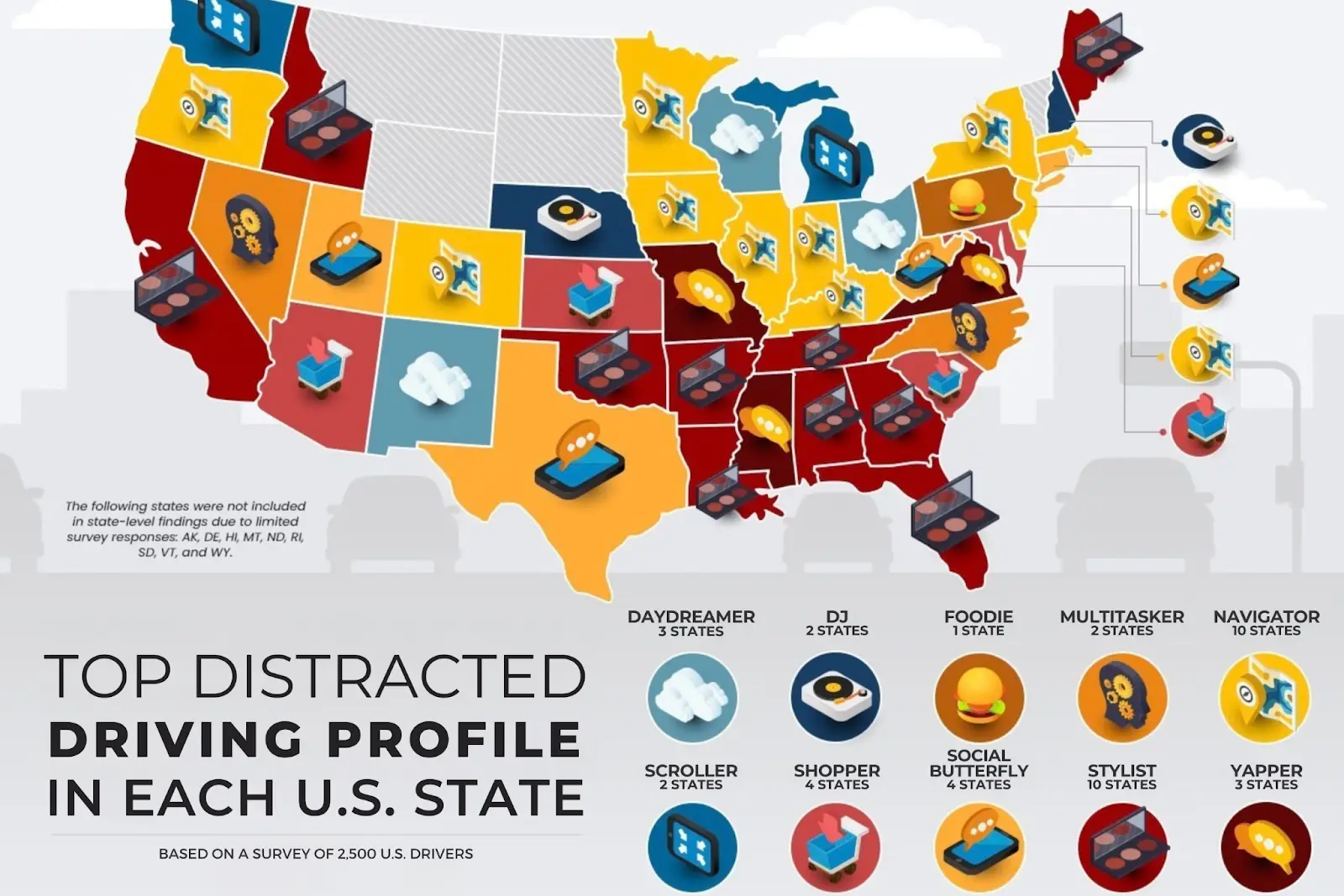
When distracted driving behaviors are grouped into profile types, two stand out clearly nationwide: “The Stylist” and “The Navigator.”
“The Stylist,” which is the top profile in 10 states, is especially prevalent among Southern drivers, leading in states such as Alabama, Florida, Georgia, Louisiana, and Tennessee, while also appearing in larger states like California.
“The Navigator,” the most common distracted driving profile in 10 states, is most prevalent in the Midwest and Northeast, ranking first in states such as Illinois, Indiana, Massachusetts, New Jersey, and New York.
States Reporting the Most and Least Distracted Driving Behaviors
While distracted driving happens nationwide, some states report noticeably higher levels of self-admitted distractions behind the wheel.
Drivers in Alabama report the highest average participation rate across the listed distracted driving behaviors, at 45%. 72% of Alabama drivers report making phone calls using a handheld device while driving.
Close behind are Georgia and Massachusetts (42%), followed by West Virginia (41%) and Tennessee (40%).
In Georgia, one behavior stood out: 79.5% of drivers admitted to adjusting navigation or maps while driving, making it one of the most widely reported distractions in the state. Meanwhile, in Massachusetts, 76% of drivers admitted to reading or sending text messages while behind the wheel.
On the opposite end of the rankings, several states reported lower levels of distracted driving.
New Jersey ranks lowest overall, with drivers averaging a 29% participation rate across distracted behaviors, the smallest share among surveyed states. Close behind are Arizona, Colorado, and Kansas at 30%, followed by Pennsylvania at 31%.
The 10 Most Common Distracted Driving Behaviors
Distracted driving isn’t just about dramatic or obviously dangerous behaviors. In reality, the most common distractions are often small, routine actions that many drivers consider harmless.
When asked which behaviors they engaged in over the past 12 months, drivers most frequently admitted to everyday multitasking: grabbing a drink, adjusting navigation, or reaching for something in the car.
On the other hand, more deliberate phone-based behaviors, like shopping online, watching short-form videos, or scrolling social media, were reported far less often.
Most Commonly Reported Distracted Behaviors
- Drank a beverage while driving (79%)
- Adjusted navigation or maps on your phone (69%)
- Reached for something in the car (69%)
- Took a phone call (hands-free) (66%)
- Ate food while driving (61%)
- Read a text message or notification (59%)
- Focused on personal thoughts instead of the road (55%)
- Looked at something outside the car instead of traffic (54%)
- Changed the music on your phone (not using steering wheel controls) (46%)
- Looked at houses, buildings, or scenery longer than intended (45%)
Least Commonly Reported Distracted Behaviors
- Shopped online or browsed products (6%)
- Watched short-form videos (10%)
- Scrolled social media feed (13%)
- Used phone to show something to a passenger (14%)
- Turned around to talk to passengers (15%)
- Groomed yourself (16%)
- Checked email (17%)
- Completed a mobile order (21%)
- Took attention off the road to respond to someone in the car (23%)
- Looked at billboards or roadside signs longer than intended (25%)
Distracted Driving Perception vs. Reality on the Road
Many drivers believe they’re attentive behind the wheel, but their own admissions suggest otherwise.
On average, Americans report engaging in 10 different distracted driving behaviors over the past 12 months, and just 8% of drivers said they didn’t engage in any of the listed distractions.
Even among the most distraction-prone drivers, confidence remains high. Of those who report participating in 20 or more distracted driving behaviors this past year, 69% rated themselves as more attentive than the average driver.
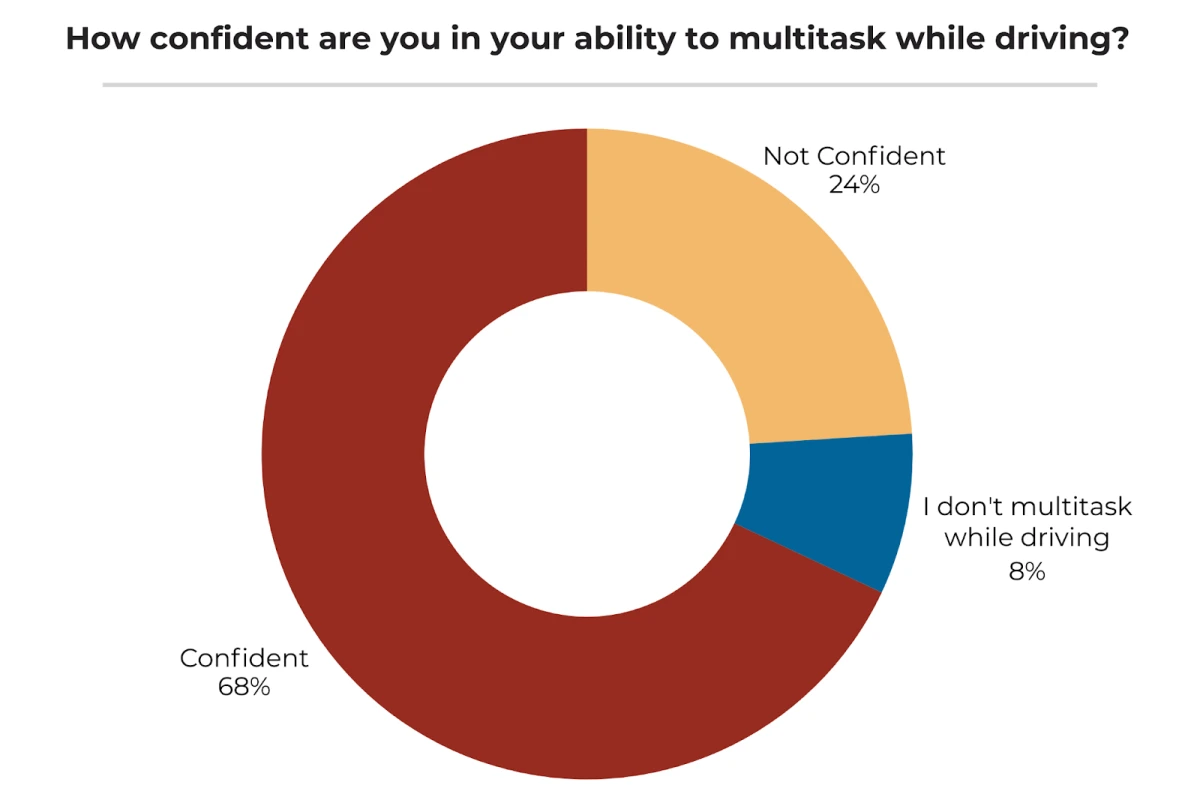
That confidence extends to multitasking. 68% of drivers said they’re confident in their ability to multitask while driving, compared to just 24% who said they are not confident.
Distracted Driving Statistics
While 69% of high-distraction drivers rate themselves as above-average in attentiveness, national statistics tell a different story.
National Distracted Driving Statistics:
- 3,275 people were killed, and 289,310 were injured in distraction-affected crashes in 2023. That equals an average of 9 deaths and 890 injuries every single day. (NHTSA)
- 8% of fatal crashes, 13% of injury crashes, and 13% of all police-reported crashes in 2023 were reported as distraction-affected. (NHTSA)
- A total of 781,958 distraction-related crashes were reported nationwide in 2023. (NHTSA)
- 611 pedestrians, cyclists, and other non-occupants were killed in distraction-affected crashes in 2023. (Traffic Safety Marketing / NHTSA)
- 397 people died in crashes involving at least one driver engaged in cellphone-related activities in 2023. (NHTSA CrashStats)
- Drivers ages 15–20 had the highest proportion of distracted drivers involved in fatal crashes (7%) in 2023. (NHTSA CrashStats)
- Drivers ages 25–34 accounted for 23% of distracted drivers and 24% of cellphone-distracted drivers in fatal crashes. (NHTSA CrashStats)
- 71% of distracted drivers involved in fatal crashes were male. (NHTSA CrashStats)
- At any given moment in 2023, 2.1% of drivers stopped at intersections were using a handheld phone. (NHTSA Observational Survey)
- U.S. teen drivers spend about 21.1% of their driving time looking at their phones. (Traffic Injury Prevention Journal)
- 49 states (all except Montana) ban text messaging for all drivers. (NHTSA)
- 29 states enforce a primary handheld cell phone ban for all drivers. (NHTSA)
Ask an Underwriting Expert: What Do These Findings Mean for Drivers?
While the data highlights how common distracted behaviors are, what do these patterns mean for real-world risk? Because distracted driving violations often impact auto insurance rates, insurers monitor long-term behavior trends closely.
To better understand what these findings mean for real-world risk, we asked Larry Anderson, Director of Underwriting Operations at Mercury Insurance, for his perspective.
The survey shows drivers admit to engaging in an average of 10 distracted driving habits annually, yet most still feel confident in their ability to multitask safely. Anderson says that the disconnect is significant.
“What stands out most is the disconnect between perception and risk. When risky behavior becomes routine, it stops feeling risky. The absence of an accident gets mistaken for proof that the behavior is safe. But driving is unpredictable, and conditions can change in seconds.’
“From an underwriting perspective, we look at patterns rather than isolated moments. Insurance pricing is based on long-term risk trends. When distraction becomes habitual, it increases the probability of an at-fault accident over time,” Anderson said.
The survey also suggests drivers may overestimate their attentiveness — something Anderson says has measurable consequences.
“Overconfidence is a risk multiplier. When drivers believe they can safely multitask, they’re less likely to self-correct those behaviors. That gap between perceived control and actual reaction time is where accidents happen. From a pricing standpoint, insurers look at outcomes — and distraction-related crashes consistently show up in claims data.”
Safer Driving Starts with Awareness
Distracted driving habits are far more common than many drivers realize, and over time, they can increase the likelihood of an accident.
At Mercury, helping drivers understand risk is part of supporting safer roads nationwide. Building safer habits behind the wheel not only protects you and others, but can also play a role in maintaining a strong driving record. When comparing auto coverage or requesting car insurance quotes, safer driving behaviors are one of the most important factors that can influence long-term outcomes.
Survey Methodology
Findings are based on a nationwide survey of 2,500 U.S. drivers conducted in February 2026 by a third-party research panel. The sample was balanced to reflect a mix of ages, genders, and geographic regions across the United States.
Respondents reported which distracted driving behaviors they engaged in over the past 12 months, including visual, manual, and cognitive distractions such as phone use, navigation adjustments, eating, interacting with passengers, and daydreaming.
State rankings were determined by calculating the average percentage of drivers in each state who admitted to engaging in the listed behaviors. Distracted driving “profiles” were identified by grouping related behaviors into broader categories and determining which category had the highest participation rate in each state.
The following states were excluded from state-level findings due to limited survey responses: Alaska, Delaware, Hawaii, Montana, North Dakota, Rhode Island, South Dakota, Vermont, and Wyoming.
All figures reflect self-reported data.
Distracted Driving FAQs
How does a distracted driving citation affect insurance premiums?
A distracted driving ticket can increase auto insurance rates by about 28% on average. The exact impact varies by state and insurer, with increases ranging from 9% to more than 50%. Because texting is often a primary offense, drivers can be stopped solely for that violation.
Does a distracted driving ticket add points to your license?
Often, yes. Many states assign 1–5 driver’s license points for texting or distracted driving violations. Accumulating points can lead to higher insurance premiums, mandatory driving courses, license suspension, or policy non-renewal in severe cases.
Can distracted driving cause a license suspension?
Yes. If a distracted driving violation results in enough license points or is tied to a crash, it can lead to suspension in some states.
Do insurance companies check for distracted driving violations?
Yes. Insurers routinely review motor vehicle records during underwriting and renewal. A distracted driving ticket may affect rating tiers, discounts, or eligibility.
Can a distracted driving ticket affect my insurance eligibility?
Yes. Multiple violations or a distracted driving citation tied to a crash may move a driver into a higher-risk rating tier or limit access to preferred insurance programs.
Can distracted driving lead to criminal charges?
Yes. If distracted driving results in serious injury or death, drivers may face misdemeanor or felony charges depending on state law.
Can a distracted driving ticket be removed from your record?
Some states allow defensive driving courses or traffic school to reduce points, but eligibility varies by violation type and jurisdiction.
What happens if distracted driving causes an accident?
If distracted driving leads to a crash, the at-fault driver may face fines, license points, increased insurance premiums, and potential civil liability for injuries or property damage. Severe cases can involve lawsuits or criminal charges.
What is the most common form of distracted driving?
Texting while driving is widely considered the most dangerous and common form of distraction because it combines visual, manual, and cognitive distraction at the same time.

Larry Anderson is the Director of Underwriting Operations for Mercury Insurance, where he leads several teams including Audit, Training, and Regulatory Compliance. Anderson has been with Mercury since 2002 when he began as an underwriter. Anderson received his Bachelor of Arts degree in Business Administration from California State University, Fullerton.

The Mercury Marketing Team is made up of professionals in the fields of Content Creation, Public Relations, Social Media and Journalism. The team works together to deliver professionally written and researched content to provide information for consumers.